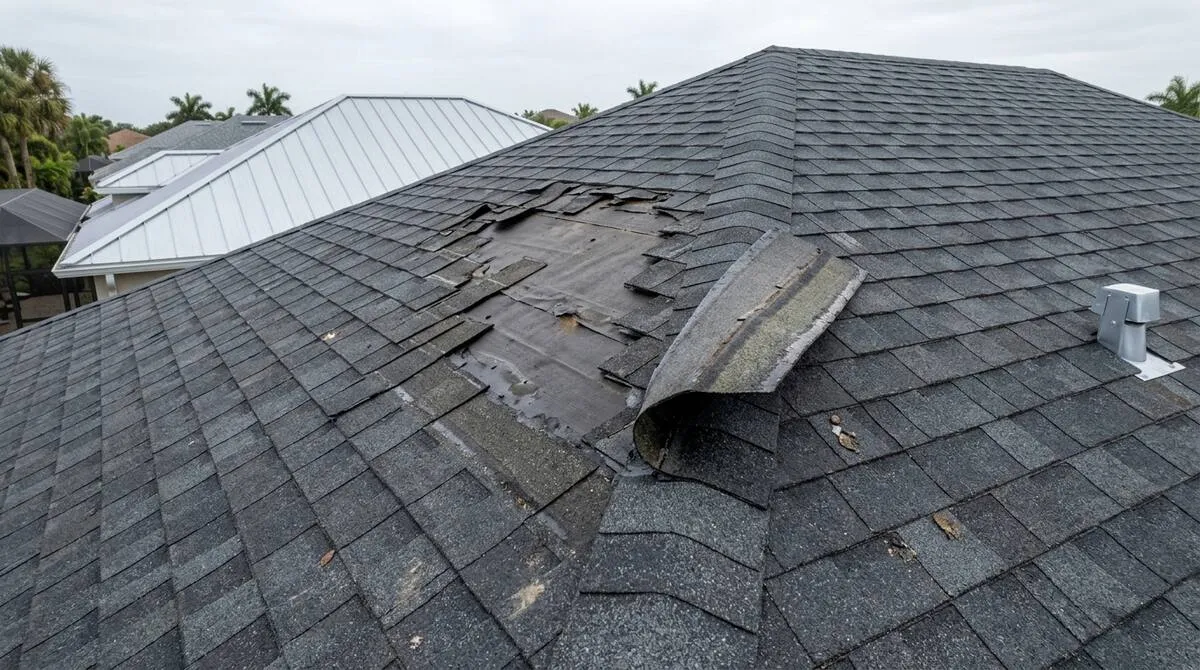
Florida’s property insurance market has changed dramatically in the last few years. Deductibles are higher, adjusters are stricter, and claims that would have been approved in 2019 are being denied in 2026. If you have roof damage and need to file a claim, here’s what actually works.
Step 1: Document everything before you touch anything
Before you make any repairs — even temporary ones — take photos and video of the damage from every angle. Capture:
- The roof surface (close-ups of damaged areas)
- The interior damage (water stains, ceiling sagging, wet insulation)
- The surrounding area (fallen branches, debris patterns)
- The date and time (turn on timestamp in your camera settings)
Store these in cloud storage immediately. If your phone gets damaged later, you’ve lost your evidence.
Step 2: Review your policy
Find your declarations page and look for:
- Deductible amount: Florida policies now often have a separate hurricane deductible (2%–5% of dwelling coverage) and an all-other- peril deductible (typically $1,000–$2,500). Know which one applies.
- ACV vs RCV: Actual Cash Value pays replacement cost minus depreciation. Replacement Cost Value pays full replacement cost. If your roof is over 15 years old, many Florida policies have switched to ACV for roofing — meaning you get significantly less.
- Exclusions: Some policies exclude “cosmetic damage” to metal roofs, or require proof of regular maintenance.
Step 3: Mitigate further damage
Your policy requires you to prevent further damage after a loss. This means putting a tarp over the damaged area if rain is forecast. Keep receipts for tarps, nails, and any materials — they’re reimbursable.
Do not hire a “storm chaser” who shows up uninvited offering to tarp your roof for free in exchange for signing an Assignment of Benefits (AOB). Florida law has restricted AOBs, but the practice still exists. AOBs give the contractor the right to negotiate directly with your insurer and pursue legal action in your name. It removes you from the process.
Step 4: Get a professional inspection
Call a licensed roofing contractor for a detailed inspection. The inspection report should include:
- Photos with labels identifying each issue
- A cause-of-damage assessment (storm vs. wear and tear)
- A repair or replacement estimate
- A statement of remaining roof life
Insurance companies distinguish between storm damage (covered) and wear and tear (not covered). A professional report that clearly attributes damage to a specific event is the single most important document in your claim.
Step 5: File the claim promptly
Most policies require you to report damage within a year of the storm, but don’t wait. The longer you wait, the harder it is to prove the damage was caused by a specific event and not by gradual deterioration.
File through your insurer’s app, website, or phone. Include:
- Your photos and video
- The contractor’s inspection report
- A brief description of when the damage occurred
- Your policy number
Step 6: Meet the adjuster
The insurance adjuster will schedule an on-site visit. Have your contractor present if possible — this prevents the adjuster from minimizing damage that a roofer would catch. It’s not adversarial; it’s just making sure both perspectives are on the record.
What to do if your claim is denied
Denials are common and often reversible. The most frequent reasons are:
- “Wear and tear, not storm damage” — This is where your contractor’s report matters most. If the report clearly links damage to a storm event, request a re-inspection.
- “Damage is below deductible” — Get a second estimate. Roofing estimates can vary by 30%+.
- “Roof is past its useful life” — If your policy covers roofs of your roof’s age, this denial is incorrect. Check your policy’s age limits.
You have the right to request a re-inspection, file a complaint with the Florida Office of Insurance Regulation, or hire a public adjuster. Public adjusters charge 10–20% of the claim but can significantly increase the payout.
We can help
We work with homeowners on insurance claims regularly. Our inspection reports are written to meet insurer requirements, and we’ll meet the adjuster on your roof at no extra cost. If you suspect storm damage, schedule a free inspection before you call your insurer — you’ll know exactly what you’re dealing with before the claim process starts.
Have questions about your roof? Gabriel's Roofing offers free inspections across the service area.