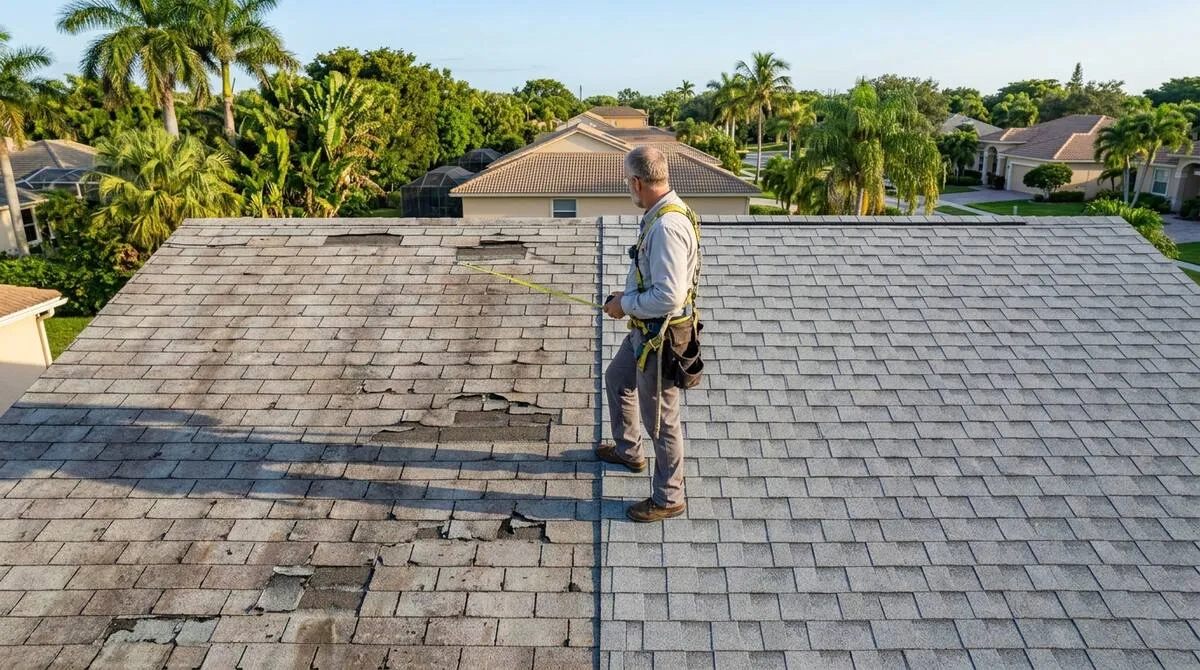
Every roofer has been to a home where the owner spent $4,000 patching a roof that needed replacement, only to call six months later with a new leak in a different spot. Repairing a roof that’s at end of life is pocketing water — you’ll spend more in total and still end up replacing the roof.
The reverse is also true: replacing a roof that only needed a $300 flashing repair is a waste of $15,000. The decision matters, and it should be based on the roof’s actual condition, not on a contractor’s preference for large projects.
Here’s how we make the recommendation, and how you can make it yourself.
The five factors
1. Age
This is the starting point. Different roofing materials have different service lives in South Florida’s climate:
| Material | Rated life | Realistic South Florida life |
|---|---|---|
| 3-tab asphalt shingles | 20 years | 12–15 years |
| Architectural asphalt shingles | 30 years | 18–25 years |
| Clay tile | 50+ years | 50+ years (tile), 20–25 (underlayment) |
| Concrete tile | 50 years | 30–40 years (tile), 20–25 (underlayment) |
| Standing seam metal | 50–70 years | 40–60 years |
| Modified bitumen (flat) | 20 years | 12–18 years |
| TPO membrane (flat) | 20–25 years | 15–20 years |
If your roof is near the end of its realistic service life, replacement is usually the right call — even if it looks okay from the ground. The underlayment and sealants are degrading even when the surface material looks fine.
2. Leak frequency
- One leak, one location: Repair. Isolated leaks are usually flashing failures and have nothing to do with the overall roof condition.
- Two leaks in different areas within a year: Repair the first, but schedule an inspection. The roof is starting to fail systematically.
- Three or more leaks in different areas: Replace. The roof is no longer protecting the home reliably, and each repair is a band-aid on a system that’s failing everywhere.
3. Extent of damage
- Isolated damage (one slope, one valley, one flashing): Repair. A single damaged area doesn’t justify replacing the entire roof.
- Damage on multiple slopes: Depends on age. If the roof is under 10 years old, repair. If it’s over 15, the damage is a symptom of systemic failure — replace.
- Damage to the decking: If an inspection reveals soft spots in the decking across multiple areas, the structural integrity of the roof is compromised. This is always a replacement situation.
4. Previous repair history
Count the repairs. If a roof has been patched more than three times in its life, the patches are telling you something: the roof is failing in new spots faster than you can fix the old ones.
We inspect roofs that have five different colors of shingles from five different repairs. That roof is done. Every patch is a leak that happened, and the next one is coming.
5. Future plans
- Selling within 2 years: If the roof is borderline, replace it. A new roof is a selling feature; an old roof is a negotiation point that costs you more in price reductions than the replacement would have.
- Staying 10+ years: If the roof has 5+ years of life left, repair and monitor. If it has less than 5, replace before you’re forced to in an emergency.
- Insurance renewal coming up: Many Florida insurers now require roofs over 15–20 years old to be replaced or they’ll non-renew. Check your policy before deciding.
The cost comparison
Let’s look at a real example: a 2,000 sq ft home with architectural shingles that are 18 years old, with two leaks in the past year.
Option A: Repair ($2,500)
- Fix both leaks, replace damaged flashing
- Expected life extension: 2–3 years
- Additional repairs likely in that period: $1,000–$2,000
- Total cost over 3 years: $3,500–$4,500
- Then: full replacement ($12,000–$15,000)
- 5-year total: $15,500–$19,500
Option B: Replace ($13,000)
- Full tear-off and re-roof
- New underlayment, flashing, shingles
- Expected life: 20–25 years
- Repairs in that period: $0–$500
- 5-year total: $13,000–$13,500
In this scenario — which is the most common one we see — repairing first costs $2,500–$6,500 more over 5 years than replacing immediately. And for those 3 years, the homeowner has a roof that might leak again at any time.
When repair is the right call
- The roof is under 12 years old
- The leak is in one location and is a flashing failure
- The decking is solid
- There’s no pattern of previous repairs
- A professional inspection confirms the rest of the roof is sound
When replacement is the right call
- The roof is at or past its realistic South Florida service life
- Leaks are occurring in multiple locations
- The decking has soft spots
- There are more than three previous repair patches
- Insurance is requiring it
- You’re selling and the roof is a known issue
How we help you decide
Our inspections are free, and our recommendation is based on the five factors above — not on whether we’d rather sell a replacement. We give you a written report with:
- Current roof condition (with photos)
- Remaining life estimate
- Repair vs replacement cost comparison
- A clear recommendation with reasoning
If repair is the right call, we tell you. If replacement is, we tell you why — and we show you the math that proves it.
Have questions about your roof? Gabriel's Roofing offers free inspections across the service area.